
A Brief History of Colored Pencils
By Louise Daley*
Today colored pencils are now considered a primary medium for botanical artists. Their path to artistic recognition took centuries. The evolution of the colored pencil spans ancient wax techniques, 19th-century industrial accounting practices, and the early 20th-century fine art revolution.
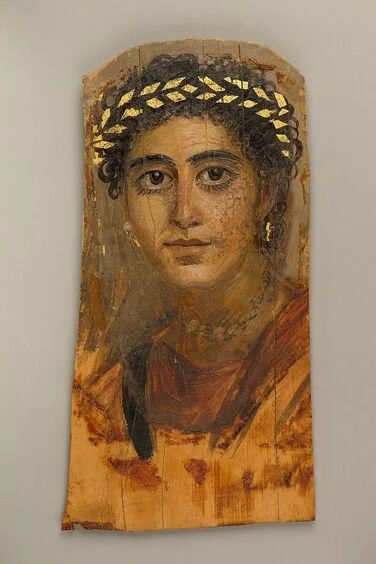
Ancient Funerary Portrait using Encaustic Wax from the Metropolitan Museum of Art
Early Inventions with Pigment with Wax
The core concept of combining pigments with a wax binder dates back thousands of years. Ancient Egyptians and Greeks utilized encaustics—a method of mixing heated beeswax with color pigments—to apply vibrant, durable paint to wooden panels and sculptures. During the Renaissance, artists used natural chalks and cured oil-and-wax crayons (such as sanguine red chalk) for drafting and figure studies. While these lacked a protective wooden casing and offered limited precision, they established the foundational binder-and-pigment chemistry used in modern pencil cores.
Use of Colored Pencils for “Non-Fine Arts”
Colored pencils were strictly utilitarian. In the 1830s, manufacturers like J.S. Staedtler in Nuremberg, Germany, developed early wax-based colored lead encased in wood. These early pencils—primarily produced in red, blue, and black—were engineered for accountants, editors, and factory supervisors to check ledgers, mark blueprints, and make edits. By the mid-to-late 1800s, European pencil makers began experimenting with wider pigment ranges. In 1860, Creta Polycolor offered a palette of nearly 100 shades, catering to draftsmanship, mapmaking, and technical illustration. The Creta Polycolor product line originally dates back to 1846, when the manufacturer G.W. Sussner was founded in Nuremberg, Germany—the historic capital of pencil-making.
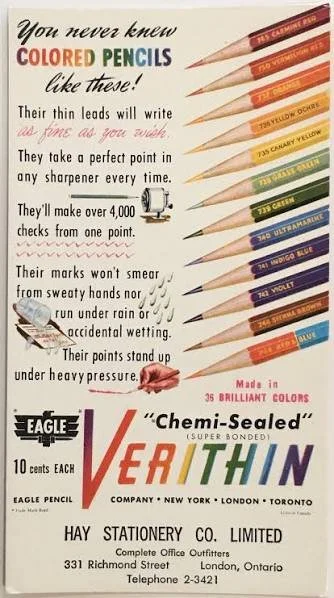
Ad for Eagle Company Colored Pencils
The 1920s Color Pencil Revolution
Lacking the lightfastness, structural integrity, and pigment density needed for fine art archival work, colored pencils were confined to “non-fine arts” tasks.
In the 1920s, two European manufacturers altered the landscape by engineering artist-grade artist pencils. In 1924, Swiss maker Caran d’Ache and German firm Faber-Castell introduced high-grade colored pencils featuring refined wax-and-oil formulas. These cores offered higher pigment concentrations, smooth application, and improved light resistance, giving artists control comparable to graphite alongside rich, layerable color. Shortly thereafter, British manufacturer Derwent (Cumberland Pencil Company) and Germany’s Staedtler expanded into artist-quality lines.
In the United States, the Eagle Pencil Company introduced the Prismacolor line in 1938. Known for its soft, heavily pigmented wax core, Prismacolor became a staple across North America for design rendering, commercial illustration, and fine art.
“Non-Fine Arts” to Fine Arts
The colored pencil secondary status has stepped up be and is now a medium for gallery artwork as a result of advanced binder formulations, lightfastness standards, and professional societies like the Colored Pencil Society of America (CPSA) established in in 1990 providing formal recognition, exhibitions, and advocacy for artists using the medium.
An overview of this historical trajectory is detailed in From Red Chalk to Rainbow: The History of Colored Pencils, which highlights the evolution from basic 19th-century marking tools to modern artistic mediums.

Prismacolor Botanical Garden colors
The Fine Arts Business of Colored Pencils
The Business Insider video "Why Professional Colored Pencils Cost 14 Times More Than Crayola" explores the manufacturing science, quality control, and artist considerations that justify the high cost of professional-grade colored pencils (such as Faber-Castell Polychromos and Caran d'Ache Luminance) compared to student-grade options like Crayola.
Just like watercolor or oil paints, considerations such as high-precision ingredients & pigment formulation — pigment vs. filler ration, particle size control, bespoke recipes — and manufacturing and rigorous testing — core production, durability, wood quality and finishing touches. These standards result in archival quality and acceptable lightfastness ratings.
*this blog was written and illustrated with the assistance of AI Google Gemini