
From Studio to Spotlight
Quick Guide to Entering Botanical Art Exhibitions
By Louise L. Daley*
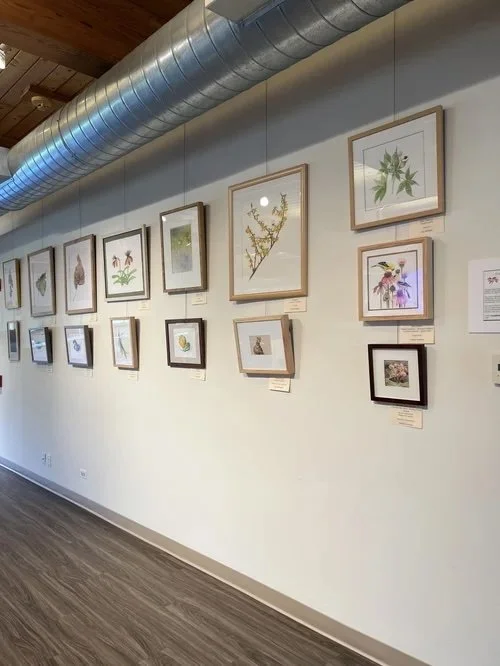
2023 Exhibition, Heller Nature Center
There is a specific kind of magic—and a fair amount of nerves—that comes with moving a piece of art from the quiet sanctuary of your desk to the bright lights of a local gallery.
Botanical art is a slow craft. It’s about the curve of a petal, the veining in the leaves, and the patience to layer media to create depths of color. But once the artwork is finished, a new challenge begins: the exhibition process.
If you’ve been thinking about submitting your work to a local show, here is a quick look at what the journey from "artist" to "exhibitor" actually looks like.
1. The Selection: Choosing "The One"
Not every piece is meant for a gallery wall. When selecting a work for exhibition, look for three things:
Scientific Accuracy: Does the anatomy of the plant make sense?
Narrative: Does the piece tell a story of a season, a life cycle, or a specific habitat?
The "Pop" Factor: Will it catch someone’s eye from across a crowded room?
2. The Presentation (Where the Real Work Starts)
You might think the art is the hard part, but framing is a close second.
The Mat: A white mat is required for botanical artwork. To protect your artwork, make sure it is acid free paper.
The Frame: Simple wood are usually required in botanical exhibitions.
The Hardware: Most local exhibitions have strict hanging requirements (usually "D-rings" and picture wire). Never show up with a sawtooth hanger.
3. The Paperwork
Entering an exhibition is 50% creativity and 50% administration. You may be required to have:
Artist Statement: Writing about the path taken to becoming a botanical artist and motive behind the artwork which intersects science and art.
The Labels: Check all information is filled and and the Latin name is spelled correctly,
Insurance Values: Deciding what time and labor are actually worth.
4. The "Drop-Off" Jitter
Once you have the artwork, the mat, the frame, the label and the correct drop of time and place, there should be nothing left to ponder.
5. The Opening Night
Walking into a room and seeing your work under professional lighting is an incomparable high. Watching a stranger lean in to inspect the serrated edge of a leaf you spent four hours painting, is the real reward
Botanical art exhibitions offers the artists and the audience a unique experience. The artwork demands of the artist a unique knowledge of plants and structure of presentation. The exhibition demands a different kind of attention from the audience — a quiet moment of observation that often crave in a busy world. Exhibiting these subtle botanical art pieces invites artists and audience to closely observe botanical subjects.
*This blog was written with the assistance of AI Gemini Google