
Writing a (Botanical) Artist’s Statement
A roadmap for artists who might feel intimidated by the writing process
By Louise Daley*
Calvin and Hobbes
by Bill Watterson
You need to write a biography to accompany your botanical artwork in a exhibition. You are being interviewed for an article about your path into the field of botanical art. You are applying for a position as artist-in-residence at a botanical garden. You have been asked to write an Artist’s Statement.
For many botanical artists, the requirement to write a statement can feel like a distraction from the actual work. However, in the professional art world, the statement serves several practical and strategic functions. Serendipitously, it gives artists the opportunity to reflect on the purpose of their artwork, whether it be to describe a particular artwork, create a body of artwork with a theme, or establish a foundational philosophy for their artistic endeavors. Ultimately, writing an Artist’s Statement helps clarify goals, which often leads to more cohesive and confident work in the future.
An Artist’s Statement helps to establish professional credibility
For galleries or exhibitions, websites or art fairs, a well-written statement proves that the artist has a "conscious" practice. It demonstrates that the work is not haphazard, but the result of intentional choices regarding medium, composition, and subject matter.
An Artist’s statement can provide a "key" to the artists intention
Visual arts, even botanical art, can be interpreted in many ways. The statement acts as a guide, telling the viewer the intent of artist in producing botanical art. Botanical art focuses on many different aspects:
Taxonomic — the deep focus on close observation and scientific accuracy for identification
Documentation — preserve a record of rare and endangered specimens in the future
Education — portraying the life cycle and physiology of plants
Inspiration — the recognition of the beauty in the designs created by nature
Spiritual — fostering a deep connection with nature as mindful meditation
Aesthetic — an exploration of light, form, texture, color, and composition
Ecology — revealing the relation between plant species and the environment
Conservation — increasing public awareness to the need to protect biodiversity
The Actual Statement
A botanical artist's statement is unique because it must balance artistic expression with scientific integrity. As a botanical artist, you need to reassure the viewer (who may be a botanist, a collector, or a casual exhibition visitor) that you understand your subject, your media, and your artistic style.
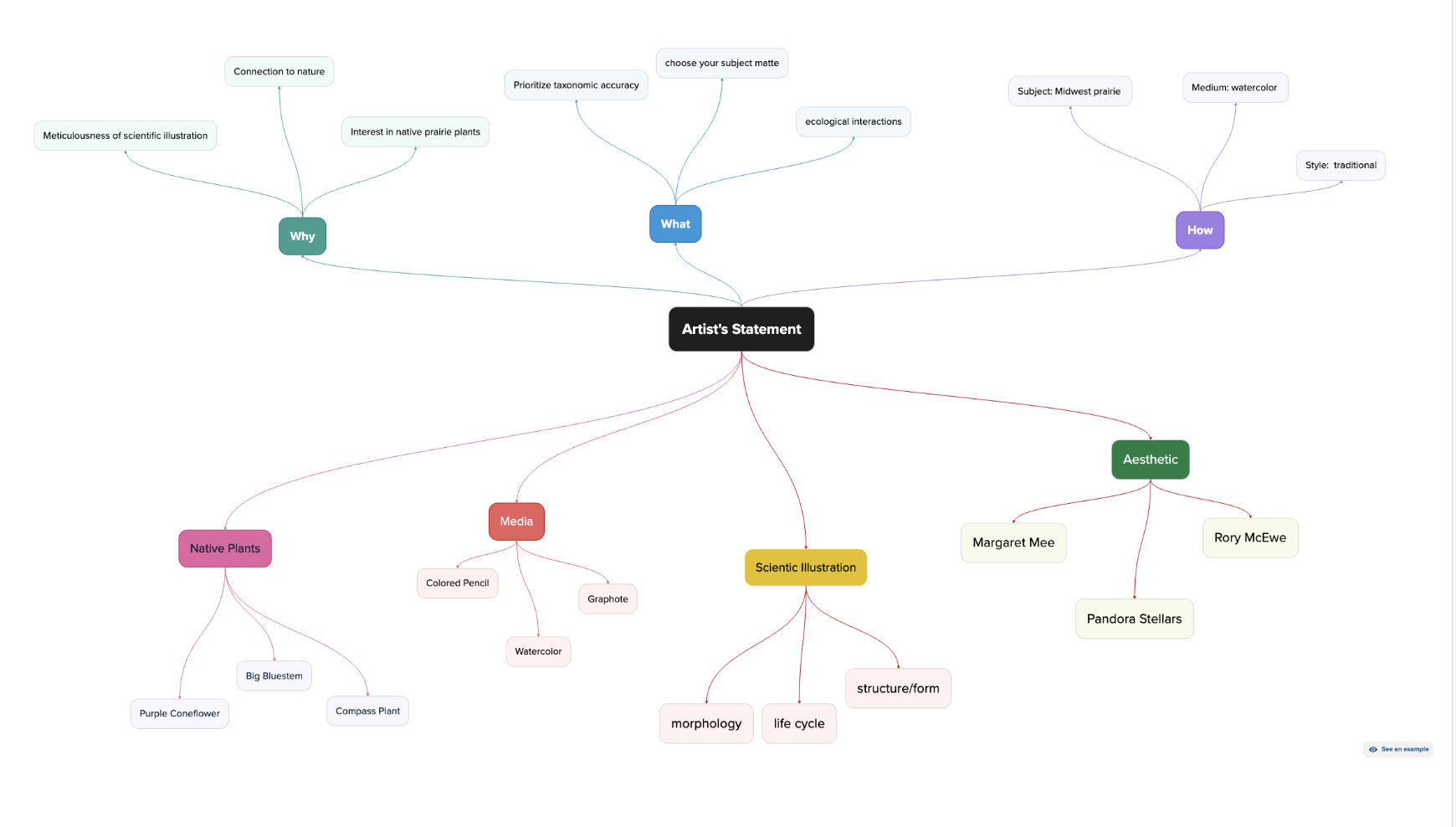
Breakdown of items to include in a professional and compelling statement:
The "Why" (The Inspiration — Reveal your motivation)
Meticulousness of scientific illustration
The phenology of plants
The unique nature of each specimen
Connection to nature
Interest in native prairie plants
Concern for endangered species
The "What" (The Subject Matter — Define your scope)
Explain how you choose your subject matter
Prioritize taxonomic accuracy or specific morphology
Reveal in composition the life cycle, habitat, or ecological interactions
The "How" (The Technical Process — Discuss your discipline)
Subject: Mention when you work from observing live specimens. This adds significant prestige to the work, as it implies a commitment to authenticity.
Medium: Specify your media—watercolor, colored pencil, or graphite. Include the substrate that might be unique like hand-made paper, vellum, or drafting film. Mention any special techniques that is used or was developed.
Style: Describe your aesthetic style — whether your botanical art is traditional, adhering to strict standards, or contemporary, pushing the boundaries of botanical art with media or composition.
The "Conclusion" (The Impact — Bring it back to your “Why”)
Describe the impact that you intend invoke in your viewer — the wonder of the natural that you endevor to portray in your botanical artwork.
Pro-Tips for Botanical Statements
Keep it Concise: 150–250 words is usually the "sweet spot" for gallery walls or catalogs.
Avoid Jargon: While you should show you know your botany, avoid overly technical terms that might alienate a non-scientist.
Use Active Verbs: Instead of saying "I like to paint," say "I investigate," "I document," or "I capture.”
The tone might change slightly depending on whether the Artist’s Statement is for a local exhibition or national botanical jured exhibition. Consider having several versions of your Artist’s Statement.
Be inspired by meditating on and writing about your botanical journey.
*This blog was written with the assistance of AI Gemini Google